
A Franciscan Gospel Reflection for the 14th Sunday of Ordinary Time 2026 is here for your prayer. What happens within you when you praise God?
 The Gospel background and reflection questions are prepared and distributed by Franciscan Sister of Christian Charity Sister Anne Marie Lom, OSF and Joe Thiel, as edited from Reflections authored by Fr. Paul Gallagher, OFM. The excerpts from the Sunday readings are prepared by Joe Thiel. To read or download the complete pdf with excerpts for your prayer, please click here:14th Sunday 2026 Franciscan Gospel Reflection
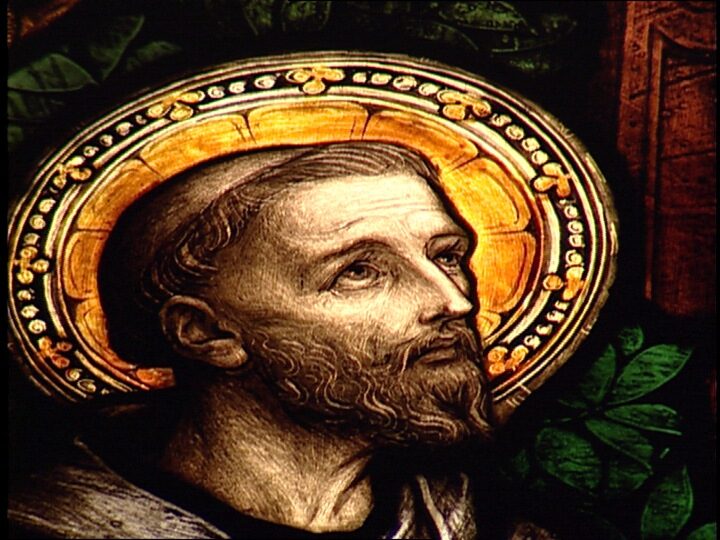
Photos: Franciscan Sisters of Christian Charity St. Francis Chapel; St. Alphonsus Church, Chicago, Illinois
Matthew 11:25-30
At that time Jesus exclaimed, “I give praise to you, Father, Lord of heaven and earth, for although you have hidden these things from the wise and the learned you have revealed them to the childlike. Yes, Father, such has been your gracious will. All things have been handed over to me by my Father. No one knows the Son except the Father, and no one knows the Father except the Son and anyone to whom the Son wishes to reveal him.
“Come to me, all you who labor and are burdened, and I will give you rest. Take my yoke upon you and learn from me, for I am meek and humble of heart; and you will find rest for your selves. For my yoke is easy, and my burden light.”
Background:
The first part of this text, verses 25-27, is also found in Luke’s gospel. (Luke 10:21-22) Therefore scholars believe that it comes from an earlier source that both Luke and Matthew used as they composed their gospels. The style of the text is different from that found in most of the synoptic gospels. It is similar to the prayerful texts found in John’s gospel. The second part of this text is unique to Matthew.
 In the second half of last week’s gospel Jesus spoke of the rewards for those who receive the apostles that Jesus sent to proclaim the reign of God. In the last verses he referred to those apostles as “little ones.” “Whoever gives only a cup of water to one of these little ones to drink because the little one is a disciple—amen, I say to you, he will surely not lose his reward.” In today’s gospel Jesus describes true wisdom not being revealed to the wise and learned but to the childlike. Later in the gospel Matthew will record Jesus instructing that in order to enter the kingdom of heaven one must “turn and become like children. (Matthew 18:3)
The religious leaders of the day had studied in depth and were considered authorities on their religious history and tradition. They took pride in their knowledge and their interpretations of what was required to maintain a solid relationship with God. Their understanding and teaching led to a general belief that one needed to maintain certain daily rituals, which only a few were in fact able to maintain.
Jesus, for his part, recognized the impossible burden that religious leaders of his day placed upon those who tried to live faithfully as God’s people. Jesus called the people to instead see the loving and merciful God of the covenant, whose burden is light in contrast to that of the religious leaders of his day. The religious leaders, for their part, rejected Jesus’ teaching, and saw him as a threat to authentic religious heritage.
Reflection Questions:
- If you can, take some time to make two lists side by side. On one, list the qualities of the wise and clever, and on the other list the qualities of the childlike. Have there been times in your life when the qualities of one side or the other dominated your relationship with God?
- As Jesus describes his relationship with the Father, it may sound intimate and exclusive. How do you feel about this description?
- What are (or have been) the burdens of your life? Where do (did) you find rest?
- Are there burdens in your relationship with God?
- What happens within you when you praise God?
- Jesus talks about God as having “hidden these things from the wise and the learned,” yet revealing them to “the childlike.” What do you think he is trying to tell us? How do you find yourself responding to this?
- Jesus invites those who are laboring and burdened to come to him and take on his yoke. How do you find yourself responding to his invitation?


Article Comments:
Joe Thiel 07/03/2026 @ 11:29 am
“Learn from me.”
In this passage, in the midst of joy and gratitude for the relief–the relief of a lighter burden, and an easy yoke , and rest for ourselves, alongside things that are hidden from the wise and the learned that are revealed to the childlike–there are these three maybe less-noticed words: “Learn from me.” I think I still have things to learn from Jesus about meekness and humility, and about taking on a yoke, when he says, ” Take my yoke upon you and learn from me, for I am meek and humble of heart.”
How do I know what happens within me when I praise God, if I’m not very good at praising God?
Sister Anne Marie Lom OSF 07/05/2026 @ 8:17 pm
What happens within you when you praise God? When I consciously praise God, I am filled with gratitude for God’s abundant goodness, love, guidance, and Presence! Praising God reminds me of who I am: beloved and cherished. Praising God calls forth a need to serve and bless others because of the abundance I have experienced. All of this is an easy yoke and a light burden.